
The Answer to the Politicization of American Christians
A vision of vocation as the new Christian worldview

A week ago, I had the privilege to hear from a younger reader of my book, “The Light in Our Eyes”, doing some important work in D.C. He thanked me for writing a book that both critiqued the over-politicization of American Evangelicals, while still, he felt, affirming his place as a Christian in the political world.
I was really pleased this bright young dude was able to pick up on this, because it’s a delicate needle to thread.
On the one hand, it’s troubling that we Christians look to political parties and packages for salvation.
And yet, I think it’s crucial that we engage in politics.
How do we solve this conundrum? The more I’ve thought about this, the more I feel I’ve found in answer in an unexpected place. But to get there, I think we need to ask: what’s the attraction to politicized Christianity in the first place?
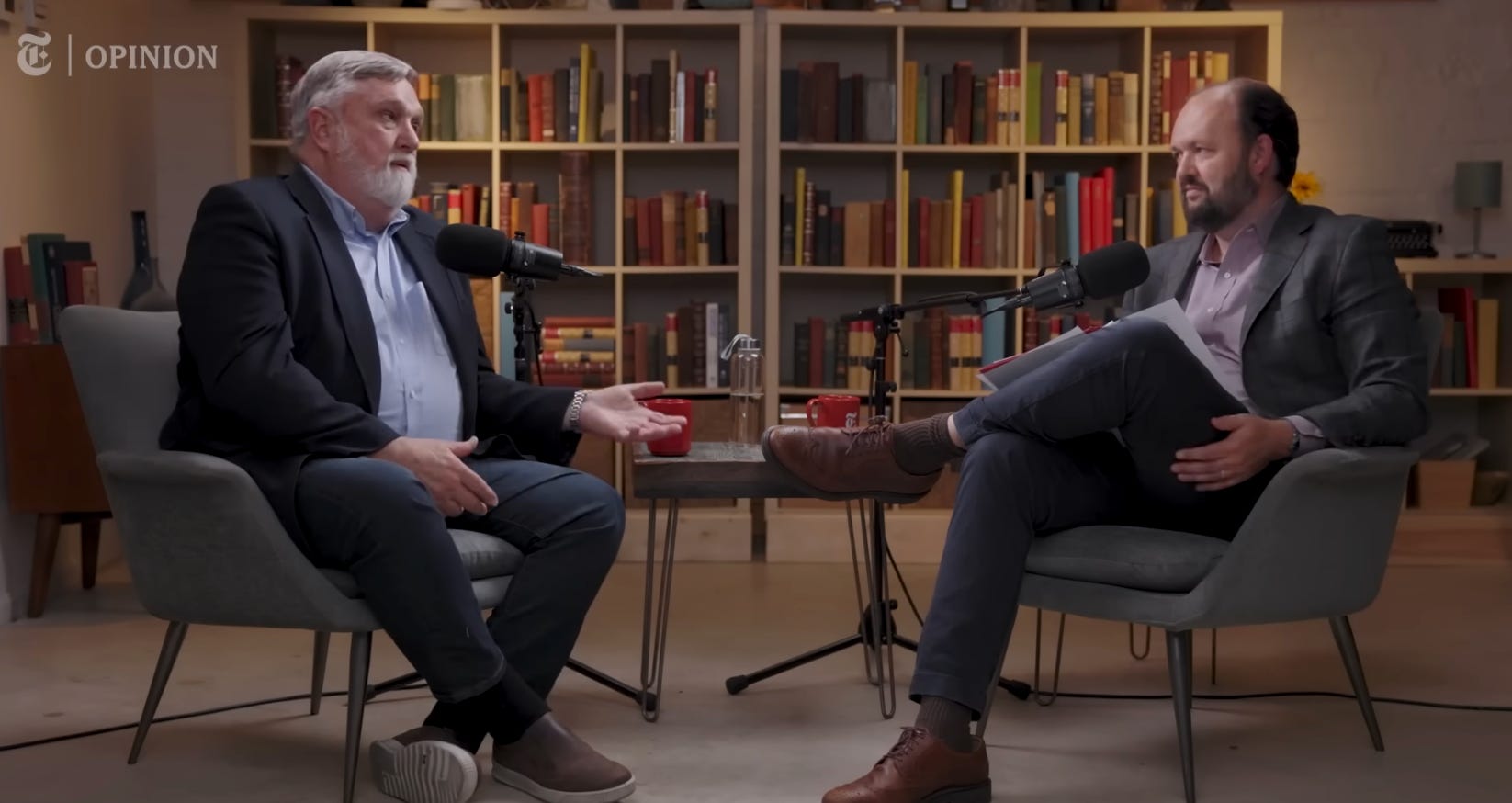
Like some of you, I recently listened to Doug Wilson’s recent interview with Ross Douthat on his vision for a Christian Nation 2.0. I find Wilson’s stuff to be pretty deplorable, personally. But I think his critics have something wrong.
So often, the response to Wilson’s very specific vision of Christian Nationalism (until you ask him for details, as Douthat does, and he becomes incoherent), is to say something like, “Well, Christianity has never been interested in power. The kingdom of heaven is not of this world.” And this, I think, is exactly the wrong response.
What Wilson is offering to folks, however biased and repulsive, is an actionable plan for the future filled with tangible hope. If our response to this is some ethereal, other-worldly pie-in-the-sky vision of Christian faith, I think we’re missing the point entirely.
Doug Wilson, much like Jerry Falwell and Richard Nixon and Tucker Carlson, are people who fill a void. Most American Protestants live without any clear social vision. And that’s sub-human. We’re designed for a social vision. So when someone comes along and says, “Here is the Christian social vision,” and we say, “No, there isn’t one,” who is going to win that fight? It’s human nature to be the former, not the latter.
So what is the alternative to Wilson’s Christian Nationalism?
Hear me out: I think it’s a deep theology of Christian vocation.
One of the issues, I think, with political packages or Christian Nationalism is that it’s making an assumption about human nature that I think is fundamentally wrong. It assumes finite human beings can wisely engage unlimited social issues. It assumes we can have a “Christian” vision of art and science and economics and philosophy etc. Thus, everyone should have a Christian Worldview: an all-encompassing pre-packaged view of every single social issue.
And while that may be an admiral pursuit (maybe), the truth is, whether it is or not, it’s simply not possible. I could not possibly master my own craft (theology) as well as dozens of other fields. So what ends up happening is that I simply adopt the positions of the people at the top, who are creating the worldview curriculums and political packages for all of us, who also don’t have a thorough grasp of these issues.
To make matters worse, these worldview positions are often themselves created in a bubble, almost always racially homogenous and highly idealistic, since none of the folks creating said curriculum have field experience.
And yet…we still need a clear vision for social engagement.
So where can we find that, if not in politicization or worldview?
This is where, I believe, the next healthy movement of American Evangelicalism would be away from “Worldview” and toward “Vocation.” What would it look like if, rather than declaring a Christian position on everything, we encouraged young people to develop a clear social vision for one thing: the vocation God has called them toward?
What would it look like if, rather than absorbing all of our social positions into the latest political zeitgeist, we had diverse groups of Christians working together to think about human flourishing in their own profession - finance, education, medicine, etc - each of whom was working from an orthodox Worldview, but whose specific social vision was informed by boots-on-the-ground concern for real people?
And what if older Christians with experience in the field helped along these younger Christians?
And what if, central to these concerns, was flourishing for everyone, but in particular the marginalized of society?
That, I think, is the real answer to Doug Wilson’s proud Nationalism: guilds of folks committed to their humble vocation. They are each waging war on the success script of profitability, and exchanging it for kingdom flourishing. They’re practitioners in their field, not theorists who decree from on high the Christian Worldview with pretended god-like omniscience.
Schaeffer’s Legacy
Just this last weekend I was field testing this idea with a friend who is very familiar with the work of Francis Schaeffer and a great admirer of his.
I suggested to him that Schaeffer was right in affirming that Christianity had something to say about every aspect of life, but that he was often wrong about what Christianity had to say about these things. I brought up the example of my friend Barb, who is a brilliant artist and philosopher. She spoke highly of Schaeffer, but, she said, he had the arts all wrong.
My friend said that’s about right: Schaeffer gave the gift of opening up the possibility that Christians could enjoy God’s common grace in the world and contribute to it. But, as my friend put it, “he often had the details wrong.” Schaeffer was fumbling toward a beautiful vision. And it’s no fair to critique pioneers on what their successors are able to do, I get that.
My point, rather, is that the people who will carry on Schaeffer’s vision aren’t worldview experts, but carpenters and philosophers and artists themselves, thinking Christianly in community about what this all means within the scope of things God has granted them.
“But we all have to make decisions about ALL the issues, say, when it comes time to vote.”
That’s true.
But two points on this.
First, imagine the resources you’d have if you could consult various Christian guilds of folks in medicine, economics, infrastructure, etc about the issues? How might that reshape the way we engage in politics?
Second, what if we reimagined the world as it really is, and took Alexis de Tocqueville’s (and of late, Yuval Levin’s and James Davidson Hunter’s) admonition seriously that in fact the fulcrum of American society is NOT the politics on top, but the “mediating institutions” - the communities which are small enough to get things done but large enough to extend their work out into the world?
That’s who influences the politicians, after all.
“But this sounds theoretical.”
It did, once. But not anymore.
That’s why I’m thrilled by the work of organizations like Praxis, who is working hard to solve industry specific problems through Christian imagination.
If what I’m saying sounds abstract, I invite you to take a look at some of the projects they have going, and see the way this can really play out in beautiful ways. Praxis is gatherings groups of Christian practitioners and entrepeneurs to imagine solutions in their own field of work to things like:
Managing technology in everyday life
Reversing the mental health crisis
Renewing Civic Engagement
Redemptive Design in the Built Environment
Redemptive Storytelling in the Arts, Entertainment and Media
I could go on.
These are Christian worldview(s) I can get really excited about.
They aren’t written out by embattled self-appointed culture warrior chiefs on podcasts.
These Christians worldviews are built for love.
Conclusion
It all seems like a strange twist, I know: instead of politics…vocation?
But the more I’ve thought about this, the more I’ve become attracted to the idea: vocational vision gives Christians a clear social vision without the dangers of moral packaging, or the need to play at omniscience.
This, I think, is what my young friend was picking up on: my book was inviting him to engage in politics as a vocation and act of service alongside wise believes who share Jesus’ concerns, without buying into the cheap political packages of our day advertising themselves as Christian Worldviews.
His worldview, however that develops, is one I get excited about.
PS - Hot tip! This coming Wednesday, my book is going on sale on Kindle. If you buy it on kindle and leave a review, I’d be happy to send you a few bonuses I sent to my early readers (discussion guides and 6 supplemental articles on reaching the dechurched).
I like this approach, especially as it is grounded at least in part in Levin's work, but the solution seems largely for established professionals and credentialed elites. On my understanding, populist energy is driven by those who have been excluded from the vocations, the downwardly mobile, the 52 year-old divorced guy in rural Virginia who feels like suburban DC professionals look down on him as a backward racist while he works part-time at a 7-11 and lives off food stamps taking care of his obese mother. The structural pressures that drive Evangelical hyper-politicization will remain I think. But I would like to be wrong.
Another problem is that there are too many Christian PhDs and MDivs and a rapidly shrinking US church, and so there's no reason to think underemployment here wouldn't also result in fighting over the remaining (status + material) resources as it does in every other professional industry, which is why some pastors continue to align with people like Wilson who create counter-elite institutions that promise them a meaningful outlet for their training and calling. Again, I like the notion of guilds and intermediary institutions and we should pursue these, but it's hard to see the distorting effects of partisan politics (religious or otherwise) going away until we resolve the immense material and structural pressures driving them.
Completely agree. That's why I've thought that both sides of politically-engaged Christianity were correct to critique apolitical, justification/salvation-only Christianity.
The trouble is that living out our faith in action starts very local and in very particular vocations. Few (if any) of us are qualified to opine about all things or the national political realm!
Thanks for spelling this out, Nicholas.