
When was Critical Theory Born?
A Helpful Perspective on Carl Trueman's Work

Hello my friends,
Many of you know I’ve been somewhat critical of Carl Trueman’s most recent projects, though I’ve historically been a big fan of his work, especially on the creeds and his historical perspective on the American church. The last few years, however, his work has felt strangely lopsided. As much as I’ve tried to air my grievances publicly, I’ve never been able to give my critique of his work quite the professionalism, polish and winsomeness Christopher Watkins has in his latest review of Carl Trueman’s most recent book on Critical Theory.
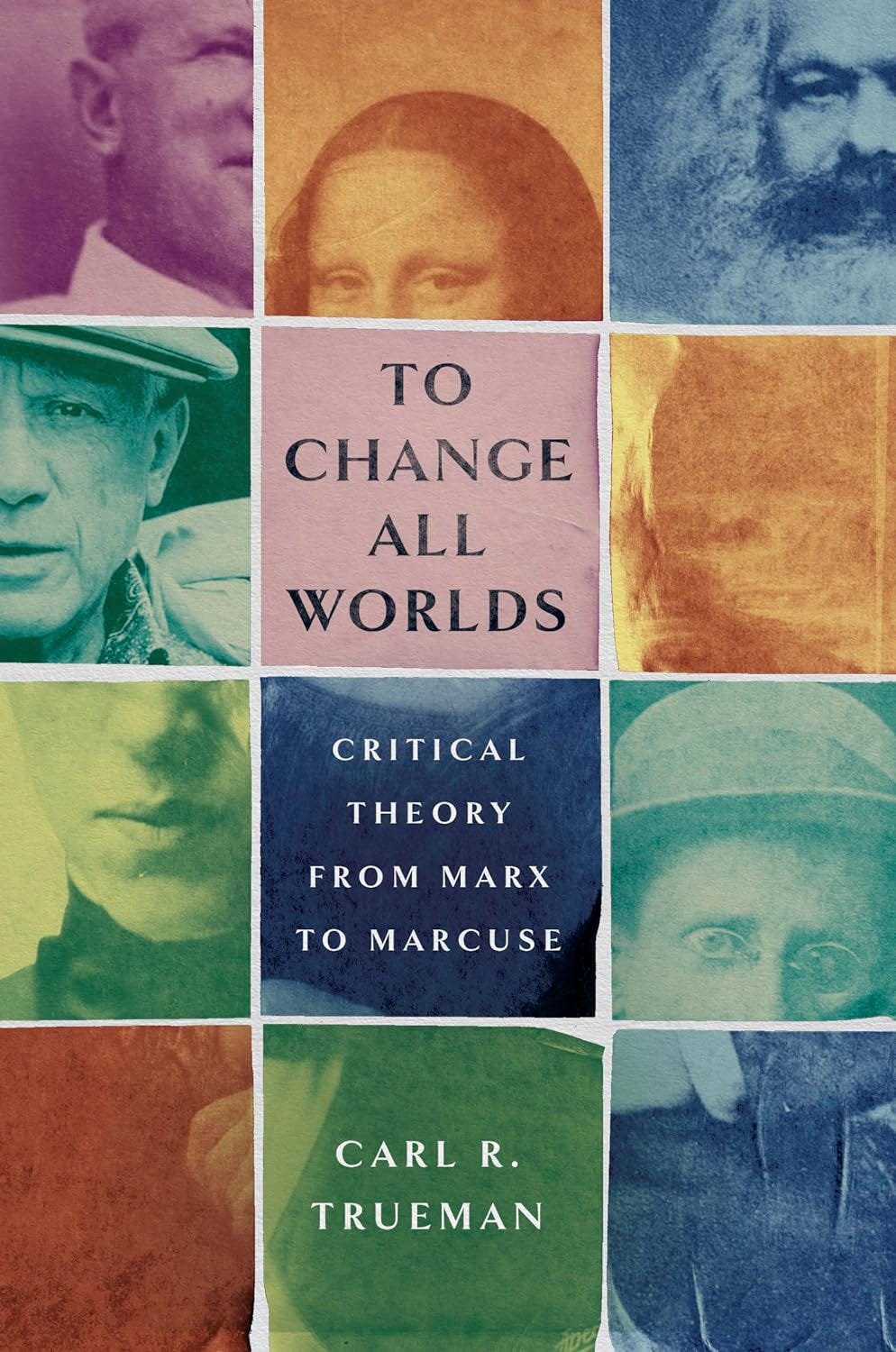
So, for today’s post…just read Christopher Watkins on Carl Trueman. Truly on the money.
Here’s a preview of his critique:
In the spirit of this double imperative to acknowledge and refute, I offer a caveat to Trueman’s approach. I find his line of argument persuasive, yet as I was reading To Change All Worlds, I regularly thought, Yes, but . . . My hesitation isn’t with what the book says but with what’s lost in what it chooses not to say.
The issue begins with Trueman’s genealogy of critical theory. He spotlights two main antecedents: Hegel and Marx. Understandable. Nevertheless, the genealogy he chooses to foreground has knock-on implications for the book’s direction and blind spots.
The Hegel-Marx-Frankfurt genealogy is one piece of a much larger jigsaw puzzle of a Christian response to modern critical theories’ complexities. It’s an important piece, but if it’s taken for the whole puzzle then Christians will have a lopsided, truncated, and unnecessarily dichotomized sense of the relationship between Christianity and critical theory. I’m not arguing that this book should say it all: such a demand would be silly. However, it’s important to read To Change All Worlds within the context of a critical theory, and a genealogy, that cannot be reduced to Hegel, Marx, and Frankfurt….
…What if, instead of with Hegel, we began with the Hebrew prophets and their critique of their society’s excesses and abuses?…What if, in Marcuse’s claim that history bends in the direction of freedom, we saw an indebtedness to an Augustinian (because it’s biblical) notion of time as linear and heading for a final judgment and righting of wrongs?…What if we began an understanding of critical theory not with Marx but with Moses, not with Hegel but with the Hebrews?
He concludes that rather than getting caught in historical narratives that eclipse the history of the church and Christian thought, we should “take the long view” of all theories - including critical theory:
Taking the long view also opens the door to approaching critical theory with the rich, supple incisiveness to which Paul subjects the Greek search for wisdom and the Hebrew desire for miraculous signs in 1 Corinthians 1. He engages wisdom and signs as cultural tendencies to be both utterly subverted (“Has God not made foolish the wisdom of the world?” v. 20) and transformatively fulfilled (“The foolishness of God is wiser than men,” v. 25). This view enhances but also transcends Trueman’s ambition to acknowledge the importance of critical theory while still refuting it.
To Change All Worlds is a profound and valuable critique of some of the most important trends of our age. It offers a constructive call for Christians to reclaim a positive, lived-out vision of humanity amid contemporary society’s fragmented and often despairing voices. Providing we don’t mistake this jigsaw piece for the entire puzzle, Trueman’s book offers a crucial contribution to the ongoing efforts of Christians to understand and minister within our late-modern world.
It’s a fantastic article, and says much better than I have what I’ve been trying to articulate about the problems with Trueman’s strangely one-sided historical narratives.