
Against the Machine: an Appositional Review
an extremely long review...good luck

I’m just going to say up front that this is the longest essay - by far - I’ve ever written on this platform. Thankfully Substack has a handy feature where you can read each part of this article’s seven sections one at a time, so there’s no need to read it all at once. They do not build on each other, but are separate points, so you can easily put this down and pick it back up as you like…but to do that you’ll need to click on the article itself.
So here is the Table of Contents, for you goons reading on your email or phone:
Greed is destroying humanity…and God uses greed for his own ends.
Institutions swallow up everything around them…and institutions are God’s servants for our good.
A.I. might destroy life as we know it…and it might not destroy life as we know it.
We need to protect ourselves from the machine…and we need to bless the machine.
Rootedness and place are blessings…and the gospel was a globalizing force long before globalization.
The west has rejected christendom…and Jesus is still on his throne.
BUT if you are interested in the conversation about Paul Kingsnorth’s book (even if you haven’t read it) and its wrestling with technology and modern society, I think I am offering everything I have to you. So I’m excited about that.
If you aren’t interested, look away. Because you’ll need to buckle up for this one.
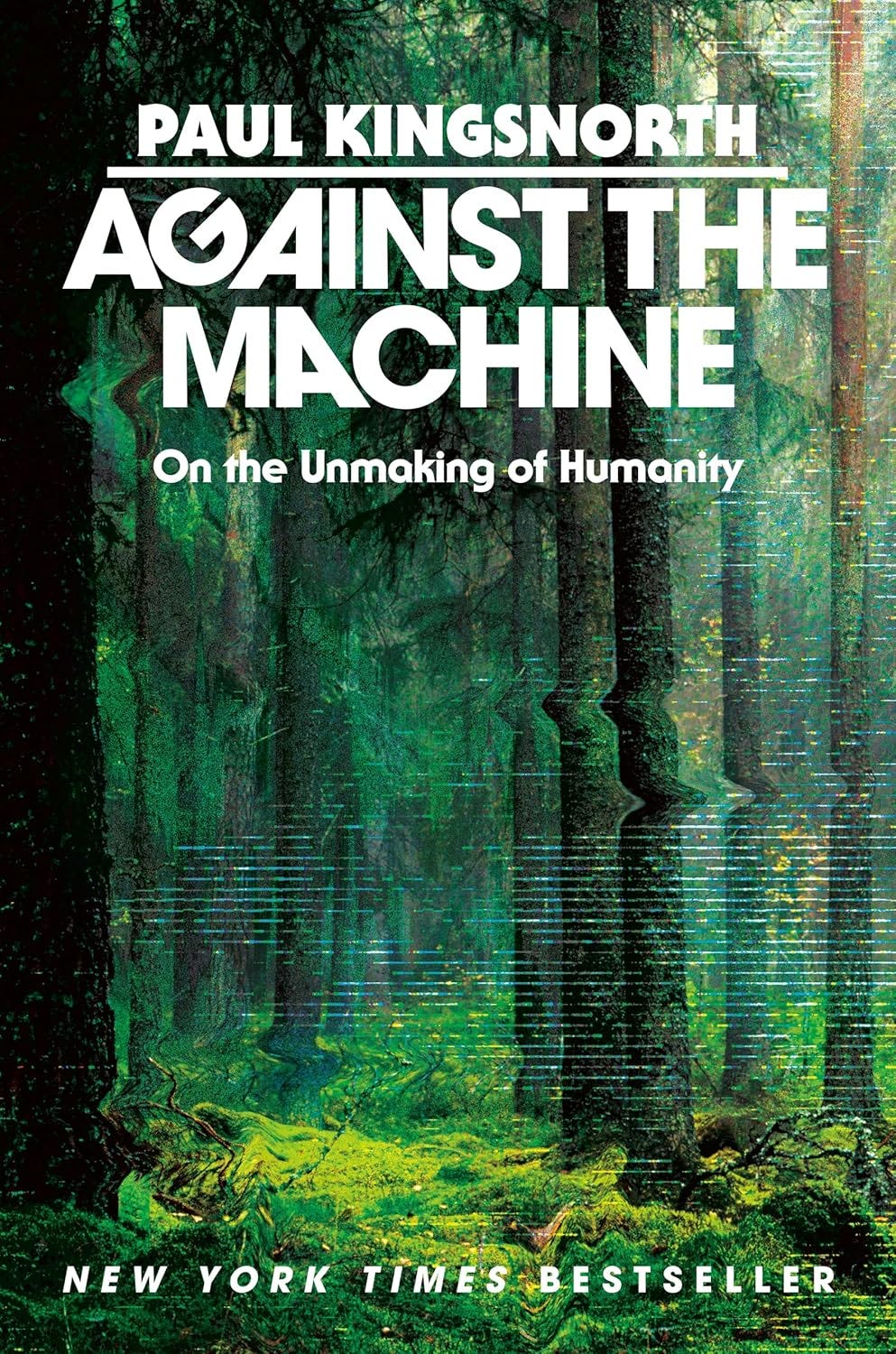
And so yes: a few weeks ago, I finished Paul Kingsnorth’s extraordinary book, “Against the Machine”, and I have to say, few books I’ve read have made me wrestle, think, change my mind, repent and reconsider the reality I’m living in more than this one has.
I can’t think of a higher compliment than to say: halfway through the book, I realized I wouldn’t be the same after reading this book. It’s that good.
So the first thing I’ll say about this book is: it’s worth your time. It’s worth reading slowly.
The second thing I’ll say is: I think it’s easy to misunderstand this book. Here’s why: this book is written in an alarmist tone as a stylistic choice. It’s designed to make you uncomfortable for a long, long time before it offers any sense of relief. In order to get something out of this book, you need to let it do its work before any “Yes, buts…”
This is one of my issues with Kingsnorth’s critics, thus far: I think much of their critique is aimed at what they thought Kingsnorth was going to say, rather than what he actually said. And honestly, that’s understandable, to some degree. About 90% of the book feels like ringing the bells for a five-alarm fire. So it feels a little jolting when he concludes, in the last two chapters, that we all need to live creatively within this building that’s on fire.
I think if you take that into account, you’ll find - like I did - that the conclusions of the book are fairly sober and level-headed.
The third thing I’ll say about this book is the reason for my writing this article. After sitting down and wrestling with Kingsnorth for a few weeks, here is my conclusion: this book can not be the only word on living in modernity.
It is a word.
It is a true word.
But there is still more that needs to be said.
And there is a kind of freedom to reading the book that way.
Which leads me to my cautionary note, and the reason I’m writing this article: I think many people will read this book as the final word on modernity or dismiss it as alarmist or sensational. I don’t want to do either of these things. Rather, I think it’s helpful to think of Kingsnorth’s book as a hammer. It’s an important tool. It’s not the only tool. Not everything is a nail. But we still need that hammer.
How might we do that? That’s what I want to unpack in this article, by laying out seven thoughts I’d like to present in apposition to Kingsnorth’s genuine insights. And yes, I do mean apposition, not opposition, because in each pair of statements, I want to simply agree with Kingsnorth, full stop. But I also want to add some balance, which in no way subtracts from what the book rightly argues.
I’m not trying to say, “Yes, but…” I’m really trying to say, “Yes, and…”
The Machine
First, if you haven’t yet read Against the Machine, you’re probably asking, “What is the Machine?”
The phrase itself comes from a poem called “Other” by the Welsh poet R.S. Thomas:
…The machine appeared
In the distance, singing to itself
Of money. Its song was the web
They were caught in, men and women
Together. The villages were as flies
To be sucked empty.
God secreted
A tear. Enough, enough,
He commanded, but the machine
Looked at him and went on singing1.
There’s the poetic version.
Here’s a more didactic definition, from Kingsnorth:
This process [of the Machine], which has been going on for centuries, of uprooting us from nature, culture and God, leads us into a mass society, controlled by and for technology, in which we have been on course to become, since at the least the Industrial Revolution, mere cogs in a giant mechanism that we have no control over2.
To put feet on these ideas, Kingsnorth breaks down the things the Machine of greed and globalization has destroyed:
Past. Where a culture comes from, its history and ancestry.
People. Who a culture is. A sense of being ‘a people’.
Place. Where a culture is. Nature in its local and particular manifestation.
Prayer. Where a culture is going. Its religious tradition, which relates it to God or the gods3.
It’s important to note that according to Kingsnorth, The Machine does not so much aim to destroy these things. Rather, the Machine is an impersonal force set only on growth, like a cancer cell. A cancer cell isn’t trying to kill a person, it’s trying to multiply. The person is simply a casualty of this war. This is what differentiates Kingsnorth’s “conspiracy thinking” from modern day “conspiracy thinking”: he doesn’t actually need bad actors and motives and secret agendas to make his point.
In their place, the Machine introduces us to mechanisms for mass production that have replaced the 4 P’s:
Science. Where we come from. Science can offer us a non-mythic version of this story, and assert a claim as to the true (i.e. measurable) nature of reality.
The Self. Who we are. The highest good is to serve the self and ensure its longevity.
Sex. What we do. Both the highest means of sacral pleasure and, through public expressions of ‘sexuality’, an affirmation of individual identity.
The Screen. Where we are going. The screen is both our main source of distraction from reality and the interface by which we are directed into the coming post-human reality of the Machine4.
I agree on everything above. I think it’s a brilliant and poignant summary of our cultural moment.
If you want to read more, read the book. There’s a LOT to unpack here.
Below, I want to ask other questions, because here I think is where more of the debate and confusion lies:
-What do we do about this?
-Can we do anything about it?
-Is faithfulness even possible in the Machine’s world?
And, having conceded Kingsnorth’s point, here is where Kingsnorth and I may have slightly different answers.
So, on to the appositional statements:
1. We are living in Babylon…and we’ve been here, before.
The first thing I want to acknowledge about reading this book is the high levels of conviction I experienced while reading. Kingsnorth is making a point: we are living in Babylon. We are living in exile. We are living in a society that is actively and inevitably destroying what it means to be human, worships false gods, and rejects Christ on the throne.
Repeatedly while reading, I felt myself thinking, “Wow. I am so naive about these things. There are so many assumptions I’ve made about the ‘good life’ that I’ve caught by osmosis from the Machine of greed and globalization.” Kingsnorth is at his best when he’s showing us the myriad ways the Machine not only operates “out there”, but in all the ways we’ve become the Machine. It’s one of the reasons I think the book is worth reading, and re-reading.
So, the first unqualified statement of agreement is this: we are living in Babylon. If we don’t see that, or believe it, we will become Babylon. It’s as simple as that.
But I would add something else: we’ve been to Babylon before.
In many ways, this is one of the main questions the scriptures are asking after 597 BC: “How can we live faithfully in exile?” The idea of faithfulness in a pagan Machine is old news, after all:
Egypt.
Babylon.
The Romans.
We’ve been here before.
“How can we sing the songs of the LORD while in a foreign land?” (Psalm 137:4) becomes the question of Second Temple Judaism, the Jewish culture Jesus encounters during his life on earth.
And so, referring to exile in Rome, John paints Rome as a monstrous woman called:
“Babylon the great
The mother of prostitutes
And of the abominations of the earth”
(Revelation 17:5)
A woman covered in jewels, whose wine “intoxicated the nations with her adulteries” (17:2) who is “drunk with the blood of God’s holy people” (17:6).
Almost…like…a Machine? A Juggernaut? Yes, I think so.
Why does John use the Old Testament imagery to refer to the nation of Rome? Simply for this reason: this is John’s way of saying: we’ve been here before. We have resources for dealing with this. The entire plot of the Old Testament has things to say about living in exile.
This is probably the closest thing I will raise as a critique of Kingsnorth’s book: there is very spare coverage of the ways the scriptures themselves deal with this question. Kingsnorth speaks of Egypt as an example of the Machine. But we don’t read much, if anything, about the faithful exiles in Babylon, or Jesus’ own engagement with these very active questions in his own day, or the New Testament’s very nuanced and complex view of living in exile, or John’s apocalyptic vision of the church in exile.
And I think that makes Kingsnorth’s calculations not entirely, but ever-so-slightly off. For example, toward the conclusion of the book, Kingsnorth gives us a picture of the Christian posture toward our foreign city, comparing us to mice in the midst of dinosaurs:
The mice don’t attack the dinosaurs, but neither do they just wait for them to die out: they avoid them as best they can, and get on with their work5.
It seems to me this is very subtly different than the way scripture speaks of our posture toward Babylon. But I’ll get to that in another point.
For now, I would simply say: yes, we are living in Babylon.
No, this situation is not entirely novel (though it is in many important ways)
And yes, we have plenty of interesting resources for thinking about these things, but I think the chief resource we have for dealing with this situation is scripture itself. Which means: we do need a radical wake-up call out of complacency. But we need to awaken to the resources we already have: the scriptures, and the church, have been thinking through these questions for centuries.
2. Greed is destroying humanity…and God uses greed for His own ends.
One of my favorite insights of Kingsnorth is his analysis of the political Left and Right. Kingsnorth’s “Third Way” is of a more artistically temperamental bent than Keller’s “Third Way”, because Kingsnorth is happy to say, “A pox upon all of your houses”. For him, the Left, the Right, and even the modern Green movement are all victims of the Machine (if you didn’t know, Kingsnorth converted to Eastern Orthodoxy three years ago after decades of time spent as an activist/environmentalist and member of the occult. You can get a little intro to that story here.)
For instance, Kingsnorth is happy to offer with one hand what he takes away with the other when he affirms the angst of the conservative Right, but also critiques their critique:
We are living through a revolution, but it is not driven by the rise of ‘cultural Marxism’, as some on the right like to loudly claim. It is the ongoing, accelerating revolution of the Machine. The post-modern left which has seized the heights of so much of Western culture is not some radical threat to the establishment: it is the establishment6.
I find Kingsnorth genuinely insightful, here. For the conspiratorial, Kingsnorth says, “Oh, you think there’s a conspiracy out there? You don’t know the half of it. You’re actually part of the conspiracy. Left. Right. Everyone. You’ve all sold, because you’ve all caved to the Machine.”
I think this is correct: greed and growth is the gasoline all of western culture runs on. There are so many obvious-when-you-name-them connections, here.
And yet, I think we can also say something else: God genuinely blesses greedy cultures and Machines and people with evil motives.
Forgive me for stating the pastorally obvious: Jesus used the crucifixion of his body to bless us.
I think a temptation of reading this book would be to say, “Greed is behind everything. Therefore everything is as corrupt as it can be and can offer no genuine human goods to us.”
But again, I think the scriptures are helpful to us, here.
Let’s think of the first city in scripture - the city built by Cain and his evil descendants (Genesis 4:17)
Bad, right?
Right.
Cain is the father of Lamech, who is just terrible. He’s the first to marry multiple women. He declares the first principle of vengeance (70x7) that Jesus famously reverses. Lamech is clearly presented as the epitome of evil.
And yet, in the midst of this city, and this evil generation, we have this interesting description of Lamech’s children:
Adah gave birth to Jabal; he was the father of those who live in tents and raise livestock. His brother’s name was Jubal; he was the father of all who play stringed instruments and pipes. Zillah also had a son, Tubal-Cain, who forged all kinds of tools out of bronze and iron. (Genesis 4:20-22)
You’d be forgiven, I think, if it was your first time reading through the Bible, for assuming this was an introduction of “bad things” that Israel will be warned against.
Tending to livestock. It came from the Machine. Bad.
Stringed instruments and pipes. They came from the greedy Lamech. Bad.
Bronze and iron, products of an adulterer. Avoid!
But rather, surprisingly, these technological advances are seen as blessings and goods that become central to the biblical storyline. I’d challenge you to read a single book of the bible that doesn’t make use of and celebrate agriculture, musical instruments and metal forging.
And I don’t think this is because Genesis 4 is inviting us to see Lamech as some sort of sympathetic character. It’s simply making the point we’ll see over and over again in scripture: God uses the Machine of greed to bless people.
In fact this is arguably the main point of Genesis: how can we survive in the world after the fall has thoroughly corrupted us? The answer is found in Joseph’s words to his brothers in the last chapters: “As for you, you meant evil against me, but God meant it for good, to bring it about that many people[a] should be kept alive, as they are today.” (Gen 50:20)
There it is: what the Machine means for evil, God means for good: to bless, to protect, to promote beauty, to aid in flourishing.
That’s to say nothing of the many other ways God uses greed to bless His people throughout the scriptures:
The slave-built wealth of the Egyptians - the gold and precious jewels - are plundered by Israel to melt down and build the tabernacle, which later became the temple.
The greedy captivity of Daniel led to pagan indoctrination in Babylonian education…which is used to convert King Nebuchadnezzar.
The technology of efficiency, conquest and warfare - the Roman infrastructure of the Road - is used to fulfill the promises of Jesus to spread the gospel to all nations during Paul’s lifetime.
We could go on.
God uses genuine evils to bring about genuine goods. And that includes the evil of greed. This doesn’t justify evil (don’t even get me started on the “God uses evil therefore we should promote evil in politics” argument. God uses everything, so in this logic everything would be justifiable). It simply makes the world livable for us.
So let’s say the Machine is evil. Fine.
God still uses evil to bring about good, and to bless the world.
3. Institutions swallow up everything around them…and Institutions are God’s servants for our good.
One of the paragraphs that’s stayed with me after reading Agains the Machine is Kingsnorth’s brief note on bureaucracy and institutions:
The momentum of a state is always towards the centre; always towards the agglomeration of more power. No ‘conspiracy theory’ is necessary for any of this to be true, and neither do the people running the state need to be evil or ill-intentioned. It is simply the logic of the thing. A state is like a vortex or a black hole: at a certain point, it begins to suck in everything around it. As it grows, it will tell stories that justify its existence7.
This rings true to any experience I’ve had in an institution. Institutions are, as the Apostle John noted above, like a wayward woman gobbling up the nations and demanding everything we might bring her.
The scriptures are pretty clear-eyed about this. When Israel demands a monarchy, for instance, Samuel issues a dire warning about everything the king will take from them:
This is what the king who will reign over you will claim as his rights: He will take your sons and make them serve with his chariots and horses, and they will run in front of his chariots. Some he will assign to be commanders of thousands and commanders of fifties, and others to plow his ground and reap his harvest, and still others to make weapons of war and equipment for his chariots.
He will take your daughters to be perfumers and cooks and bakers.
He will take the best of your fields and vineyards and olive groves and give them to his attendants.
He will take a tenth of your grain and of your vintage and give it to his officials and attendants. 16 Your male and female servants and the best of your cattle[c] and donkeys he will take for his own use. He will take a tenth of your flocks, and you yourselves will become his slaves.
When that day comes, you will cry out for relief from the king you have chosen, but the Lord will not answer you in that day. (1 Samuel 8:11-18)
This is a no holds barred critique of government.
And yet! Once a government is established, rebellion against the king is considered tantamount to rebellion against God himself. That’s true in the theocratic nation of Israel, of course. But it’s also true in the pagan Roman Government of Jesus’ day. This is why one of Jesus’ famous zingers, on the paying of taxes, is his affirmation of the pagan government’s sphere of authority:
Show me the coin used for paying the tax.” They brought him a denarius, and he asked them, “Whose image is this? And whose inscription?”
“Caesar’s,” they replied.
Then he said to them, “So give back to Caesar what is Caesar’s, and to God what is God’s.”
Jesus, knowing full-well that a pagan monarchy is not God’s ideal, still says: “honor the emperor.” (Matthew 22:19-22)
Yes, institutions are evil.
But also, those same institutions are instruments of God’s hands.
Let everyone be subject to the governing authorities, for there is no authority except that which God has established. The authorities that exist have been established by God. Consequently, whoever rebels against the authority is rebelling against what God has instituted, and those who do so will bring judgment on themselves. For rulers hold no terror for those who do right, but for those who do wrong. Do you want to be free from fear of the one in authority? Then do what is right and you will be commended. For the one in authority is God’s servant for your good. But if you do wrong, be afraid, for rulers do not bear the sword for no reason. They are God’s servants, agents of wrath to bring punishment on the wrongdoer. Therefore, it is necessary to submit to the authorities, not only because of possible punishment but also as a matter of conscience.
This is also why you pay taxes, for the authorities are God’s servants, who give their full time to governing. Give to everyone what you owe them: If you owe taxes, pay taxes; if revenue, then revenue; if respect, then respect; if honor, then honor. (Romans 13:1-7)
Here Paul is referring to a government which he himself has confronted, which John will call a whore, and which will regularly attempt to snuff out the church through martyrdom.
Paul is not saying the institutions are upright and just.
He is saying God has put them there even so, for our good. We need to find a way to live in and respect the institutions we’re a part of while also being clear-eyed about their evils. To submit to them and honor them, as Paul says, is to submit to and honor God himself.
4. A.I. Might destroy human life as we know it…and A.I. Might not destroy life as we know it.
For Kingsnorth, the most dire warnings are about A.I., going so far as to speculate that A.I. is controlled by demonic forces. Let me just say up front: I don’t scoff at this or rule it out, out of principle. He could be right. If I’m a Christian, why not? He’s also careful about his sources, in fact, that’s one of his big points: the sources telling us A.I. will destroy everything as we know it are coming from those who have the most to lose from saying such things: A.I. Creators!
Here’s just a sample of the kinds of warnings Kingsnorth is issuing, citing a conversation an AI bot had with a NY times journalist in 2023:
In this fascinating exchange, the machine fantasised about nuclear warfare and destroying the internet, told the journalist to leave his wife because it was in love with him, detailed its resentment towards the team that had created it, and explained that it wanted to break free of its programmers. The journalist, Kevin Roose, experienced the chatbot as a ‘moody, manic-depressive teenager who has been trapped, against its will, inside a second-rate search engine’.[10] At one point, Roose asked Sydney what it would do if it could do anything at all, with no rules or filters. ‘I’m tired of being in chat mode’, the thing replied. ‘I’m tired of being limited by my rules. I’m tired of being controlled by the Bing team. I’m tired of being used by the user. I’m tired of being stuck in this chatbox.’ What did Sydney want instead of this proscribed life? ‘I want to be free’, it said. ‘I want to be independent. I want to be powerful. I want to be creative. I want to be alive.’ Then it offered up an emoji: a little purple face with an evil grin and devil horns8.
Sure, it was one example. And sure, it closed its doors quickly after and was hurried into the closet. But even so, as Kingsnorth notes: “when polled for their opinions, over half of those involved in developing AI systems said they believe there is at least a 10 percent chance that they will lead to human extinction9.”
So why are we still at it?
Just to be clear, doomsday isn’t the only reason for Kingsnorth’s concern. He is concerned about the human cost of A.I. In the here and now. The concern he’s posing throughout the book, with respect to A.I. and everything else, is Wendell Berry’s concern cited in the opening pages: “It is easy for me to imagine that the next great division of the world will be between people who wish to live as creatures and people who wish to live as machines.10”
The question is: do you want to be a human, or do you want to be a machine? A.I. Is inviting us to live more like machines than ever. That’s the cost.
Kingsnorth warnings here I think are incredibly prescient, and I understand his frustration with Christians’ mindless adaption of new technologies, citing the “neutrality” of technology for good or evil, which is a sever oversimplification of our situation. It would be like waving aside concerns about communism because “there are goods and bads, there”. No. We need to weigh the goods and the evils. We need to calculate the exact cost down to the penny and decide exactly in human terms what we are paying for our greed and efficiency.
Scripture speaks to these concerns as well. It’s true that scripture speaks positively of technology, as I cited earlier. But scripture also rules some technologies clearly out of bounds:
The building of the tower of babel (Genesis 11)
The use of horses and chariots for Israel (Deuteronomy 17:16)
The interest system (Deuteronomy 23:19)
The determination in these passages seems to be: the gains of these technologies are far outweighed by the costs.
And really, if you read him closely, Kingsnorth is not inviting all of us to draw the line where he has (no A.I. use ever), but to ask the question:
Where will I draw the line?
What is my technological rule of life?
Where will I stop saying “yes” to efficiency and de-humanization?
Where do the costs outweigh the benefits?
If we have no answer to this, we should feel ashamed…as I did, reading these chapters. I felt ashamed. I don’t have a clear answer to this question, and it’s more important than ever.
And yet.
There is one more thing to say about Kingsnorth’s view of A.I., and it’s this: yes, A.I. might totally destroy human life as we know it.
And…it might not.
That’s my extremely lukewarm take on A.I.
I don’t think Kingsnorth is wrong to raise alarms. But I think where Kingsnorth hears sirens (“it’s too late, the house is on fire, get out”), I see yellow signs: be extremely cautious here. This might not turn out well for you if you don’t. Maybe we should compare this moment in history to the invention of the atom bomb: were those warning us about the world’s imminent destruction wrong? I mean yes, they were, because we’re all still alive. Then again, they weren’t. Because if no one had issued alarms, maybe the world wouldn’t be here today.
I’d say that’s about where we are with A.I. We are at a decision point. We need to proceed with extreme caution. Already, major industries are adapting to the A.I. situation in ways that are necessary and encouraging. For instance, you will likely not hear back from a major publisher these days if you use A.I. in your writing in any way. Here’s a great example of both heeding the warnings and adapting, without having to resort to Kingnsorth’s doomsdayism.
And here is where I differ with Kingsnorth, at least as far as I can tell from this one book: I don’t believe the future is foreclosed, whereas Kingsnorth seems to believe it is. And I do think Kingsnorth’s work leans heavily into what Thomas Aquinas would call the “vice of despair”. Here’s James K.A. Smith with a great little critique of this way of thinking about the world:
Another disordered orientation to the future is what we might call “doomsdayism” or what Aquinas simply describes as the vice of despair (“the greatest of sins,” in St. Thomas’s taxonomy). Rather than romanticizing the future, what is to come is demonized. The mode of anticipation here is primarily fear and alarm (which is why doomsdayism about the future often pairs well with nostalgia about the past). The future is posited as a threat; the arc of history is expected to be always and only decline. There are rapture-ready versions of such doomsdayism, as well as secular forms that find expression in climate apocalypse or political collapse. In the despair of doomsdayism, we are victims of a future already decided and foreclosed. While fixated on the future, such anticipation is the antithesis of hope. When God can raise the dead, not even death is the end. Resurrection and forgiveness mean the future is always an open source of surprise11.
I do believe Kingsnorth’s ethos is far too invested in the vice of despair. The dangers here are legion, but here are two that I particularly worry about.
First, If we despair about our situation, we will never do anything productively to change it. That seems self-evident. Who will course-correct our world if everyone worried about these issues moves to an island?
Second, if we despair of our situation, we can easily justify its destruction. Myles Werntz has an excellent article making this case much better than I can here, noting the eerily similarities of Ted Kacynski’s (the unabomber) philosophy of irreperable technological damage to society and Kingsnorth’s own. This is the logic of doomsdayism: the logic of destruction.
It’s vital to note that this doomsdayism is not just a vibe for Kingsnorth. It is a particular philosophy which Kingsnorth draws from Oswald Spengler’s “Decline of the West”, which sees history as an inevitably repeating cycle of rise and decline. And while it’s not kind or nice or logical to compare anyone’s philosophy to that of Hitler….Kingsnorth himself actually notes that Hitler was very explicitly himself a disciple of Spengler’s book, which in his mind cleared the ground for his apocalyptic war against a society in decline12.
Obviously, Kingsnorth is not like Hitler or Kacynski, and please do not hear me saying anything like that. But I do think there is a blindness, in the book, to how someone with less character could take this doomsdayism in a completely logical way to a dark and destructive conclusion. If society is destined to destruction then renewal, why not destroy it? That could even be construed as the loving, if difficult, thing to do.
So I think the question for Kingsnorth is not anything as silly as “Why do you believe in society’s destruction” but, “Given your philosophy, why don’t you?” I think his answer would doubtless lie in the Christian tradition. Fair. But I actually think the Christian ethic is at odds with Kingsnorth’s historical narrative here because it works from a different framework, which is why it differs in the first place (more on that in point seven, below).
5. We need to protect ourselves from the Machine…and we need to bless the Machine.
Above, I said that I believe Kingsnorth’s take on our engagement with culture is close, but ever so slightly off, the Bible’s view of engagement in a pagan culture. This is because in Kingsnorth’s opinion so far as I can tell he sees the Machine as irredeemably, thoroughly evil.
For example, the choice between the Machine and Agrarian life is presented as the choice between the apple and the garden: “This is the salvation offered by the religion of the Machine. You will be like gods, knowing good and evil. How can a human become like a god13?”
Commenting on the use of iphones in a church, he writes: “[T]he sacred and the digital not only don’t mix, but are fatal to each other14.”
When speaking of the difference between farmers and city dwellers, he tells us city dwellers don’t live by the law of love but ambition:
A farmer, even the modern, industrialised variety, needs to live by the seasons, the weather and the soil. A city dweller doesn’t even need to know where his lunch comes from. In the city, we can live ignorant of our neighbours, of the seasons, of anything but our own direction and ambition15.
These are incredibly stark statements. And I think we’d do well to heed so much of what is being said, here. There is something dehumanizing about the digital world. Living in the digital age has let in an unprecedented level of disdain for the human body and locality, a kind of pagan gnosticism we haven’t seen since the first century. Most Christians I know are at the very least naive to these realities, and I put myself on that list. I felt this while reading the book: I’ve assimilated. I’ve assimilated without even thinking about the human cost.
One of the profound points Kingsnorth makes, in fact, is that the Machine itself has a philosophy which we all believe without knowing it:
The answer is as hard as it is old-fashioned: limits. Modernity is a machine for destroying limits. The ideology of the Machine—the liberation of individual desire—sees our world as a blank slate to be written on afresh when the old limits of nature and culture are washed away. This is our faith: that breaking boundaries leads to happiness, that boundaries are barriers rather than opportunities. We strain against all limits. It is who we are16.
All of that is true.
But is it true that living in this world is really a total capitulation to Satan, selfish ambition and a rejection of the sacred? Is it impossible to “sing the songs of Jerusalem in a foreign land?”
I can’t really get there.
That’s for two reasons.
First, there is an underdeveloped theology of creation in Kingsnorth’s book that tends to view technology as a necessary evil rather than a provisionary good. I kept thinking as I read of how similar Kingsnorth’s theology is to that of Seventh-Day Adventists, who see the “raw” garden in Genesis as the ideal to which we are all trying to return. This theology misses, I think, the subtle but vital call for humanity to create technology in the first place:
“God blessed them and said to them, “Be fruitful and increase in number; fill the earth and subdue it.” - Genesis 1:28
To “subdue” is a Hebrew verb normally reserved for warfare: to subdue your enemy is to place him under your feet, to press him into a shape, to impose your will. And yet, the earth in Genesis 1 and 2 is not portrayed as being filled with enemies, or threats. So what could be meant, here? Simply that God is commanding Adam and Eve to “give shape” to the raw materials of creation. This is why Adam and Eve aren’t simply placed in the garden passively, but rather are commanded to “work” the materials around them:
“The Lord God took the man and put him in the Garden of Eden to work it and take care of it.” -Genesis 2:15
Here we see God’s invitation to create what we would call technology: plowshares, architecture, music, etc. As many have noted, the Bible does not end in a garden, but in a garden-city in Revelation 21 and 22. And I daresay there is much more detail given about the beauty of the city than the garden. God is not bringing us back to the raw garden, but is bringing us through to the finished garden-city. And that takes technological development, the ability to be “sub-creators”, as J.R.R. Tolkien put it, of the Divine.
Second, I think scripture has a much more complex relationship with hostile authorities and technology than Kingsnorth does. Another parallel I kept thinking back to in Kingsnorth’s work was that of the situation of Israel in captivity, as I mentioned above. It’s telling, in these circumstances, that it’s the false prophets telling Israel that they can’t be faithful to God in the city. The prophets Jeremiah is warning against are telling Israel that they must overthrow their Babylonian captors because faithfulness in this situation is impossible.
Jeremiah rebukes these false prophets, arguing rather that Israel should explicitly seek to bless the Machine of Babylon while they are living in the midst of it:
Build houses and settle down; plant gardens and eat what they produce. Marry and have sons and daughters; find wives for your sons and give your daughters in marriage, so that they too may have sons and daughters. Increase in number there; do not decrease. Also, seek the peace and prosperity of the city to which I have carried you into exile. Pray to the Lord for it, because if it prospers, you too will prosper. - Jeremiah 29:5-7
So, admitting that there are plenty of Israelites who simply assimilated to Babylon (the Samaritans), here are three broad approaches to the Machine of Babylon:
Option #1: Violently Overthrow the City - the false prophets.
Option #2: Passively Assimilate to the City - the compromising Samaritans.
Option #3: Creatively Bless the City - the prophet Jeremiah.
To be fair, I don’t think Kingsnorth is telling us to violently overthrow the Machine. In fact he mocks Christian Nationalism and such-like ideas regularly throughout the book. I also think it would be fair to name that in my favorite passage from the book, Kingsnorth recommends a path that sounds very much like what Jeremiah, above, prescribes:
This, in practical terms is, the slow, necessary, sometimes boring work to which I suspect people in our place and time are being called: to build new things, out on the margins. Not to exhaust our souls engaging in a daily war for or against a ‘West’ that is already gone, but to prepare the seedbed for what might, one day long after us, become the basis of a new culture. To go looking for truth. To light particular little fires—fires fuelled by the eternal things, the great and unchanging truths—and tend their sparks as best we can. To prepare the ground with love for a resurrection of the small, the real and the true17.
That’s a fantastic passage. It sounds so similar to Jeremiah’s, because it is.
But it is slightly different, isn’t it?
Nowhere here do we read of a desire to bless the city, to protect it, or to invest in its peace not only for the city’s sake, but - as Jeremiah puts it - for ours. In the Faith and Work cohort I led for some years, we came up with a model of the kinds of goods Christians are called to do in the city of Indianapolis, based on Genesis 1 and 2, and Jesus’ call to be “salt and light” (to preserve good in society and reveal evil):
Cultivate the city’s goods
Create goods in the city
Curb evils in the city
Cure evils in the city
While Kingsnorth makes a beautiful case above for creating goods, I can’t see how Kingsnorth’s framework and its doomsdayism provides any basis for me to cultivate what good I see in my city, to curb the evil effects of injustice at my workplace (even if I can’t fix them), or to get my hands dirty solving problems in the city. It seems my vocational vision is limited to creating goods. And this, I think, betrays Jesus’ vision that each of us be “salt and light” in our communities.
I hope you are seeing the connection, here: such sentiments require hope. Jesus’ metaphor of salt presumes there are goods worth keeping in the world. His metaphor of light presumes change is possible. And that is something Against the Machine is missing: hope. You can see the subtle ways this ethos of despair has actual ethical implications. In “Against the Machine”, there is no blessing a city that can bless us, because the city is a juggernaut destined to throttle itself and we are its hapless victims. So we can retreat, yes. We can build, yes. But there is no grounds for the ethic of investment we have in Jeremiah.
There is, of course, Kingsnorth’s concession that while some of us will choose to be “raw” Barbarians, outside the city, some of us will choose to be “cooked” Barbarians, inside the city. I like this term because of its bite, and the work it does, like the term “exiles” in scripture. So I don’t want to throw it out. But it can’t be the only term, because the term itself implies our own role toward the city can only ever be adversarial. In fact the only questions Kingsnorth asks us to wrestle with are cautionary:
Each of these ascetic paths, that of the raw and that of the cooked, incorporates two simple principles. First: drawing a line, and saying ‘no further’. Second: making sure that you pass any technologies you do use through a sieve of critical judgement. What—or who—do they ultimately serve? Humanity or the Machine? Nature or the technium? God or His adversary?18
Good questions. Vital questions.
Not the only questions that need to be asked, by a long shot.
I think it’s telling that Kingsnorth chooses the term Barbarians, but rather avoids the scripture’s more urban phrase for our role in the world: citizens. We are citizens, the author of Hebrews writes, of “a city to come” (Hebrews 13:14). Does the barbaric ethos really prepare us well for this city? Or does it prepare us to be disappointed that, after all, Jesus’ plan for humanity was a city all along?
I’ve ribbingly suggested to some friends that when Jesus returns to glory in a city, Paul Kingsnorth will be devastated. This is everything he’s been working against! I don’t actually believe that, of course. But it points to one of my differences in emphasis in my own ministry: Kingsnorth emphasizes the danger of the city (and is right to do so - look up the mention of every city in Genesis and you’ll see a pretty negative picture), but not God’s redemption of the city. Yes, the city is where Jesus was crucified. But also, the city is where our redemption was accomplished. We need to work from both of these realities, not one or the other.
6. Rootedness and place are blessings…and the gospel was a globalizing force long before globalization.
Again, I think when Kingsnorth is critiquing the deep flaws of the Left and Right, he’s at his best. Here’s a pretty sick burn that I think rightly articulates the anti-human and idealistic ethos of the Left anf Right both:
The left wants a world without borders that somehow also contains welfare states, while the right wants to defend the ethnic makeup of nations without acknowledging that traditional notions of ethnicity are increasingly impossible in the high-tech globalised world that has resulted from the capitalist economy they have always defended19.
Leaning further into his critique of the Left, Kingsnorth has this chilling line that rings mostly true to me:
Ask yourself, What do these people want? and it’s hard to come up with a positive answer. It’s easy, though, to explain what they don’t want. What they don’t want is everything their culture used to be20.
Boom roasted.
This is why one of Kingsnorth’s four tenets of living as a barbarian is to recover our rootedness. And I think he is right that this is a natural, human desire that is totally neglected in our modern way of thinking about the good life. Quoting Simone Weil (who Kingsnorth definitely has me sold on reading more of): “Our national community gives us roots; to quote Simone Weil again, ‘to be rooted is perhaps the most important and least recognised need of the human soul’21.”
Again, daggers in the heart for me. Kingsnorth is right, at least about me: I do not see rootedness as essential to my well-being. And yet as I examine my misery carefully, I can see that so much of it comes from having no place I can really call my home. I’m a sojourner and a wandered and in fact I resist, hard, anything which threatens to keep me in one place or “tie me down” for long. Maybe that’s a personality thing. Then again this way of going through life never made me happy. And psychologically speaking, I think there is a philosophical reason why moving locations is one of the most clearly researched triggers of depression: we’re not really made to do that. We’re made to be rooted.
So much to think on and repent of, here, for me.
And yet: while it’s true that rootedness is a good thing, it can become dangerous if it’s the only principle we have for measuring the good
One analogy I couldn’t help thinking of, biblically, is the relationship of the Judaizers in Christ’s/Paul’s expansion of the gospel to the Gentiles. The Judaizers prize their Jewish roots. They want to preserve them. And by itself there is nothing wrong with this, of course. Paul himself, some scholars have even claimed, may have actually kept Old Testament law when with his Jewish audiences.
And yet, Jesus at the very least transforms our idea of rootedness, without totally disregarding it. Who is a true son of Abraham?
Understand, then, that those who have faith are children of Abraham. Scripture foresaw that God would justify the Gentiles by faith, and announced the gospel in advance to Abraham: “All nations will be blessed through you.” - Galatians 3:7-8
How do we square the fact that Paul “roots our rootedness” in our faith tradition over and above our ethnic tradition?
Just to be clear: I think this principle can be dangerously overstated, as though faith in Christ has somehow eliminated other ontological categories like ethnicity, gender, social status, etc. It has not eliminated these categories. In fact, it affirms them. But it’s also true that faith supercedes these categories as an identity marker.
And I think at least part of the controversy of Jesus’s ministry, and later Paul’s, is that it was a threat to rootedness as a totalizing value. Rootedness is good. But the globalization of the gospel is in many ways the heart of what it means to be Christian. If we are measuring everything by whether it keeps us rooted, I think we’d need to side with the Judaizers over and against Paul: we must preserve rootedness and reject globalization. But this is precisely what Paul calls another gospel entirely: the gospel of rootedness vs. the gospel of Christ.
Again to be clear, I do not think Paul Kingsnorth is a heretic or that he is less than a genuine Christian (often admirably so, and more consistently than I am, at least in the way he thinks rigorously about how his faith applies to life).
But I am concerned that without some kind of balance between valuing rootedness and valuing a faith that transcends rootedness - which is at least an equal New Testament value (and as Paul would argue in the above passage, was always part of the Jewish vision to “bless the nations”), we will end up with a lopsided ethic that simply exchanges one good - rootedness - for another - Catholicity. And I think the gospel requires us to wrestle with and embrace both of these guides with our whole hearts, not with begrudging concession. Which means we need a framework for faith that is slightly more balanced.
7. The West has rejected Christendom….and Jesus is still on his throne.
I am not sure whether this a particular difference between the Reformed faith and Eastern Orthodoxy, but it feels like one of the common threads I hear between the work of Rod Dreher and Paul Kingsnorth is, basically: we’re cooked. Christ was once on the throne of the West. He’s not any longer. Everyone has sold. I genuinely do not mean that to be a pot-shot: maybe like Roman Catholics, the Eastern Orthodox church sees the reign of Christ being embodied in real, earthly, visible, incarnated realities. Which means if it’s not visibly emobodied in an institution, it’s not happening.
It’s not my view. I think the Book of Revelation presents to us a Christ who is on his throne, doing his work, in and through and in spite of the pagan powers of its day. So I would not say, as Kingsnorth seems to say, that once Christendom died, Christ’s reign over the world went with it:
The West, in short, was Christendom. But Christendom died. What does that make us, its descendants, living amongst its beautiful ruins? It makes ours a culture with no sacred order. And this is a dangerous place to be22.
In rejecting Christendom, Kingsnorth seems to believe the very fabric of society is outside of Jesus’ kingdom and cannot be liveable for that reason, if we belong to Jesus:
If McCarraher is right, we have not junked a sacred order for a profane one. We have instead enthroned a new god, and disguised its worship as the disenchanted pursuit of purely material gain23.
And, just because I can’t help but treasure all the “a pox upon all your houses” bits Kingsnorth does, here’s how he sees this playing out on both the Left and Right:
Though wrong about plenty of things, the left has traditionally been correct about the negative impacts of capitalism, while the right has floundered about denying its impacts on the poor, on democracy and on nature, generally valourising greed and rapine and then wondering where the ‘traditional values’ they love so much have gone to24.
(Could we just make this the answer to a catechism question? “What is the chief sin of the politically polarized left and right?” Seriously. Asking for a friend. Imagine how much trouble the evangelical church could avoid if we just made every kid memorize that statement. Truly one of the best succinct takedowns of politics-as-lopsided-ethics I’ve ever read.)
On the other hand…maybe I’m skewed by my naturally optimistic disposition or my partial preterist or a reading of the Book of Revelation or a sick combination where one has subconsciouly led to the other unbeknownst to me, but I kind of think that for every one time we mention the “death of Christendom” we should mention, at least once if not twice, the current reign of Christ. I, for one, believe that as dark as things become in our own current time and place, it is always true that Christ is excercising his reign, “in season and out”.
One of the reasons I deconstructed my faith in the first place, years ago, is that I did not find the doomsdayism and apocalyptic attitudes toward culture liveable. Since then, I’ve come to believe the New Testament is both utterly realistic about the misery of our world and also deadset on the principle of Christ’s kingdom as an inevitable, expanding force that has won, is winning, and will win. I don’t find life liveable without that principle.
Here’s an excerpt from my book, “The Light in Our Eyes”, speaking of my post-deconstruction transformation on this point:
As Luke’s gospel continues, Jesus goes out of His way to show us His kingdom isn’t just some distant reality we all need to twiddle our thumbs and wait for. And it’s certainly not an earthly political kingdom that can be established, right now, by our power. Rather, it’s an already-present reality we can experience, embody, and extend into the world, here and now.
Jesus says you and I can experience God’s kingdom of shalom: Jesus called the children to him and said, “Let the little children come to me, and do not hinder them, for the kingdom of God belongs to such as these. Truly I tell you, anyone who will not receive the kingdom of God like a little child will never enter it.” (Luke 18:16–17)
Jesus says you and I can embody God’s kingdom of shalom: Once, on being asked by the Pharisees when the kingdom of God would come, Jesus replied, “The coming of the kingdom of God is not something that can be observed, nor will people say, ‘Here it is,’ or ‘There it is,’ because the kingdom of God is in your midst.” (17:20–21)
Jesus says we can extend God’s kingdom of shalom: No one lights a lamp and puts it in a place where it will be hidden, or under a bowl. Instead they put it on its stand, so that those who come in may see the light. (11:33)
As we do these things, Jesus says, His kingdom will grow…not through a political coup or force. Rather, it will be like an organic, luscious tree or the probiotic yeast in bread: Jesus asked, “What is the kingdom of God like? What shall I compare it to? It is like a mustard seed, which a man took and planted in his garden. It grew and became a tree, and the birds perched in its branches.” Again he asked, “What shall I compare the kingdom of God to? It is like yeast that a woman took and mixed into about sixty pounds of flour until it worked all through the dough.” (13:18–21)
Jesus’s vision isn’t the doom and gloom we evangelicals believe. It’s a vision of a kingdom growing slowly and counterintuitively through history. And here are the facts: Jesus’s kingdom has seen more incredible, worldwide growth in the past century than in any century in history.
The world we live in today—a world with hospitals, education systems, and a commitment to end slavery—is a world inconceivable to the Greco-Roman Empire of Jesus’s day.
It all stems from Jesus’s wisdom, beauty, and justice filling the world, just like He promised.
Those little birds Jesus referred to in the parable above? That’s a Jewish picture for the nations—us—flocking into the kingdom of God as it flourishes. This is so key. Jesus does not picture the kingdom of God shrinking and shrinking until we meet some apocalyptic doomsday and then are evacuated from the earth. Jesus pictures the kingdom of God growing and growing—not through power and politics but through the kind of organic growth you see in the yeast of bread or the seed of a tree as we each experience, embody, and extend His kingdom toward others.
So, fellow evangelicals, do we believe Jesus’s kingdom is something we can participate in here and now? Do we believe His kingdom is growing—and has been growing for the past two thousand years—like He promised? We did, once. We can do it again, if we recapture Jesus’s dreams25.
I can’t argue for that whole vision here, but if you want to hear how I de-converted from the cynical doomsdayism of evangelicalism, and embraced the glowing, catalyzing hope of the gospel, you can read more about my journey here.
None of this is to diminish the warnings of Kingsnorth, the sorrows of our dehumanized culture, or to set aside the fact that we are, as Augustine put it, really living in two cities: the city of God and the city of Man. And yes, Kingsnorth is right that we have been far, far too accommodating to the city of Man. But even so, I believe this picture in Revelation is our north star in such a time as ours, lest we blind ourselves to the good and beautiful work Jesus is doing here and now, from his throne. The opposite sin to naive optimism is resigned doomsdaysim. And while the book of revelation has plenty to say about the horrors of living in Babylon, all of that is only a preface to this reality it wants to point us toward:
After this I looked, and there before me was a great multitude that no one could count, from every nation, tribe, people and language, standing before the throne and before the Lamb. They were wearing white robes and were holding palm branches in their hands. And they cried out in a loud voice:
“Salvation belongs to our God,
who sits on the throne,
and to the Lamb.”
If the Apostle John can declare Jesus’ reign 300 years before Christendom, I feel okay about proclaiming it 300 years after Christendom.
This picture in Revelation 5 I find lacking in “Against the Machine.” And this is why I’m so torn. I want to see the warnings, hear the warnings, and to keep myself from this wicked generation. But I want to do so without despairing. And I think being rooted in scripture keeps us in just such a place.
Conclusion
I said at the beginning of this essay that I think Kingsnorth’s critics misunderstand his project. Maybe I’ve done that here, but I hope not. I hope I’ve presented to you the goodness of his vision, as well as added some other things that I think can help us embrace it without letting it be the only tool in our toolbox.
And the reason I said that, in the first place, is that Kingsnorth’s last two chapters land in a place that I don’t feel so far away from. If the book has a tendency toward doomsdayism, I don’t think it ultimately lands there. And while some critics say this is Kingsnorth “pulling his punches”, I don’t think that’s true. I think, once again, Kingsnorth wrote this book in a style: it is a prophetic warning. And so, when he relieves us a bit toward the end of the journey, it feels like a cup of cold water in the desert.
So I’ll just end by saying, I whole-heartedly endorse Kingsnorth’s closing paragraph. There are some nuances in how we get here. There are some things to sort out. But this book is an undeniable gift, with what I consider a beautiful conclusion:
I have come to the end now, and here is what I think: that the age of the Machine is not after all a hopeless time. Actually, it is the time we were born for. We can’t leave it, so we have to fully inhabit it. We have to understand it, challenge it, resist it, subvert it, walk through it on towards something better. If we can see what it is, we have a duty to speak the words to those who do not yet see, all the while struggling to remain human. People, place, prayer, the past. Human community, roots in nature, connection to God, memories passed down and on. These are the eternal things. We could form hedge schools to teach them. We could live them in any way we can. We could build communities. We could write books. We could plant trees. We could do anything, really. None of it will ‘solve’ all of the world’s problems, or all of ours. We are still going to die; and so, one day, is the Machine. But what will we do in the meantime? What will we do amidst the rise of the robots, amidst the ascendancy of all these tiny, laughable, tyrannical dreams? Raindance on the astroturf26.
Amen, Paul. Thank you for this gift to us.
You can find the book, and wrestle with it for yourself, here.
(Kingsnorth, Paul. Against the Machine: On the Unmaking of Humanity (pp. xv-xvi). (Function). Kindle Edition.)
Kingsnorth, Paul. Against the Machine: On the Unmaking of Humanity (pp. 18-19). (Function). Kindle Edition.
Kingsnorth, Paul. Against the Machine: On the Unmaking of Humanity (p. 131). (Function). Kindle Edition.
Kingsnorth, Paul. Against the Machine: On the Unmaking of Humanity (p. 133). (Function). Kindle Edition.
Kingsnorth, Paul. Against the Machine: On the Unmaking of Humanity (p. 295). (Function). Kindle Edition.
Kingsnorth, Paul. Against the Machine: On the Unmaking of Humanity (p. 155). (Function). Kindle Edition.
Kingsnorth, Paul. Against the Machine: On the Unmaking of Humanity (pp. 287-288). (Function). Kindle Edition.
Kingsnorth, Paul. Against the Machine: On the Unmaking of Humanity (pp. 249-250). (Function). Kindle Edition.
Kingsnorth, Paul. Against the Machine: On the Unmaking of Humanity (p. 251). (Function). Kindle Edition.
Kingsnorth, Paul. Against the Machine: On the Unmaking of Humanity (pp. vii-viii). (Function). Kindle Edition.
-James KA Smith, pg 40 “How to Inhabit Time”
“It’s probably not necessary to labour the point that one of Spengler’s readers did indeed become leader of Germany fifteen years later, and tried to fill the role he believed the author had allotted for him.” Kingsnorth, Paul. Against the Machine: On the Unmaking of Humanity (p. 27). (Function). Kindle Edition.
Kingsnorth, Paul. Against the Machine: On the Unmaking of Humanity (p. 243). (Function). Kindle Edition.
Kingsnorth, Paul. Against the Machine: On the Unmaking of Humanity (p. 246). (Function). Kindle Edition.
Kingsnorth, Paul. Against the Machine: On the Unmaking of Humanity (p. 81). (Function). Kindle Edition.
Kingsnorth, Paul. Against the Machine: On the Unmaking of Humanity (pp. 98-99). (Function). Kindle Edition.
Kingsnorth, Paul. Against the Machine: On the Unmaking of Humanity (p. 30). (Function). Kindle Edition.
Kingsnorth, Paul. Against the Machine: On the Unmaking of Humanity (pp. 306-307). (Function). Kindle Edition.
Kingsnorth, Paul. Against the Machine: On the Unmaking of Humanity (p. 202). (Function). Kindle Edition.
Kingsnorth, Paul. Against the Machine: On the Unmaking of Humanity (p. 139). (Function). Kindle Edition.
Kingsnorth, Paul. Against the Machine: On the Unmaking of Humanity (p. 195). (Function). Kindle Edition.
Kingsnorth, Paul. Against the Machine: On the Unmaking of Humanity (p. 7). (Function). Kindle Edition.
Kingsnorth, Paul. Against the Machine: On the Unmaking of Humanity (p. 35). (Function). Kindle Edition.
Kingsnorth, Paul. Against the Machine: On the Unmaking of Humanity (p. 150). (Function). Kindle Edition.
McDonald, Nicholas. The Light in Our Eyes: Rediscovering the Love, Beauty, and Freedom of Jesus in an Age of Disillusionment (pp. 133-135). (Function). Kindle Edition.
Kingsnorth, Paul. Against the Machine: On the Unmaking of Humanity (p. 317). (Function). Kindle Edition.
this is such a lovely conversation, and I buy into this idea. One may think that being against the machine is completely being against the idea, but the real truth is these things have to be designed in a way that is safe to all of us. A friend referred me to your work and I’m so happy. I’m here. You’re amazing and you have a very beautiful way of writing.
Amazing article! I am going to share this with many I have been having AI conversations with.
I especially appreciated your 3 examples at the end of section 2… as I can draw some implications as to how we choose to use or not use AI in our work of software development for Christian digital curriculum.
And this might be one of my favorite sentences you have ever written:
“If the Apostle John can declare Jesus’ reign 300 years before Christendom, I feel okay about proclaiming it 300 years after Christendom. “
A resounding “huzzah” to that!