
The Mission that Separates Us
A Different Take on the Space Between American Christians

Last week, Jake Meador wrote a helpful article about the different stances of Christians toward culture. I don’t find anything of substance to disagree with, and it has some extremely helpful insights. I especially appreciated Jake’s two great examples of his friend who creatively engaged with a secular threat in his workplace, as well as the ways more missional institutions have been agile in their response to campus policy.
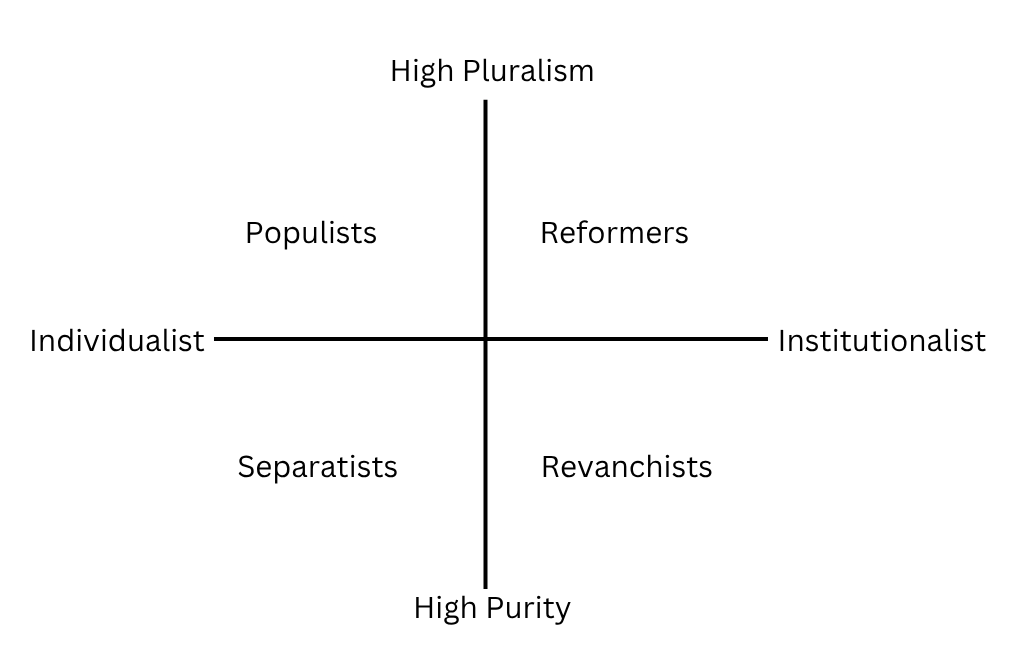
However, I did find it difficult to map myself onto Jake’s quadrilateral. I think the reason was simply this: while the quadrilateral address the trappings of different movements, in some ways, I feel it misses the heart of these various quadrants.
For example, I think according to the descriptions set out, I would be a Christian who highly values pluralism, because, as Jake puts it, I’m very willing (and eager) “to exist within spaces not owned or controlled by Christian believers.”
That’s true of me insofar as it goes. I love those spaces.
But does this mean I highly value “pluralism” as such? Not really. I don’t mind pluralism. Philosophers and politicians value pluralism. I’m fine with it. But it doesn’t make my heart sing.
More disturbingly for me, maybe, is that in this quadrilateral I’m the farthest from the value of church purity. If by purity here we mean preserving the status quo of the church, no, I don’t value that. But that’s not my definition of purity. Purity is conformity to the holiness of Jesus. And it’s actually for this very reason that I’m deeply critical of the institutions which Jake has mapped onto the high purity quadrant: the Separatists and Revanchists.
On the individualist-institutional spectrum, I also feel conflicted. I’m very much invested in Christian mediating institutions, in fact, I wrote about the importance of them last week. But I’ve also just spent a year creating a pretty sophisticated discipleship curriculum for younger folks to experience in small mentee/mentor groups. So does this put me in the Populist category? I don’t see how. I see the value in mediating institutions as well as smaller, more agile and intense discipleship movements.
It seems to me that what’s missing from the chart are the specific aims of each of the four groups. So if I could not subtract, but add to the chart, it would look like this:
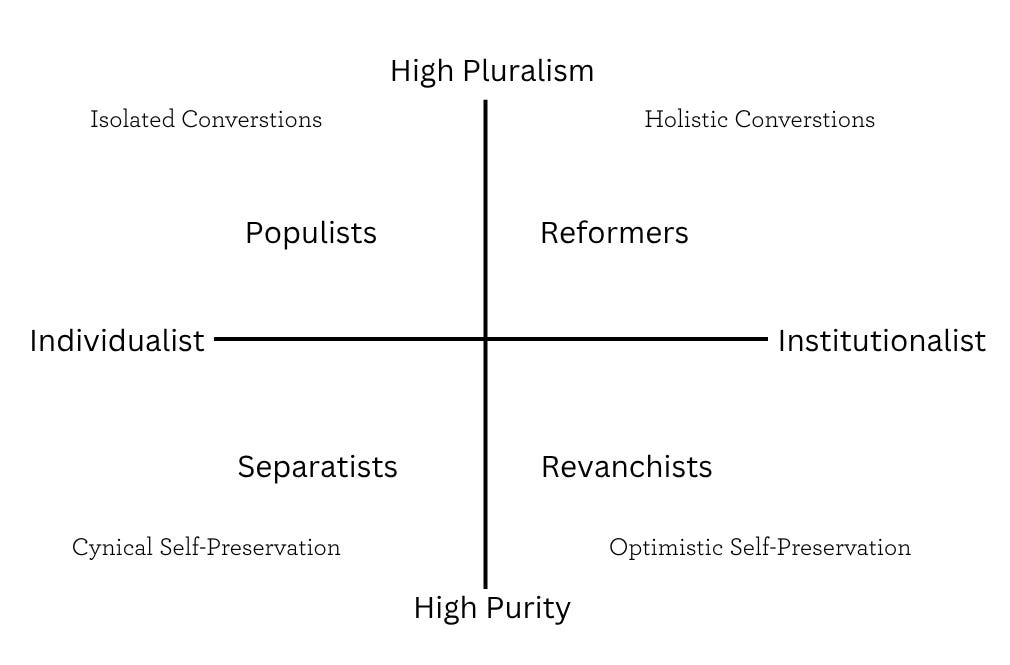
Now, this is likely much more stark than Jake’s. But I think this is the lay of the land, because it’s actually our fundamental disagreement about the aims of the church that create the wide gap between us more than anything.
So let’s walk them through:
1. The Populist Project - Isolated Conversion
What strikes me about Jake’s description of his Navigators-like friends, who wanted to see disciples made one at a time, is that I have far, far more in common with this group (as a Reformer) than the other two. And yes, I feel very comfortable in non-Christian spaces and want to be in those spaces. So do the Populists. But it’s not because we value tolerance.
It’s because we both value conversions.
For the Populists, these conversions don’t have much of a social bearing on the life of a Christian. That’s the difference. So discipleship looks like private spiritual disciplines, or being baptized and expressing yourself in that baptism by church attendance on Sundays and maybe buying a church bumper sticker, and both probably mean not doing some bad things you used to do in general.
But this is a slightly different aim than mine, as a Reformer, because although conversions are also my main aim, I see conversion as a holistic experience with public implications.
2. The Separatist Project - Cynical Self-Preservation.
As Jake points out, these Christians are highly motivated by a dispensational view of the world, assuming it’s a sinking ship which the faithful must protect at all costs. The highly politicized right-wing Christians would fall into this category.
While this crowd is ostensibly interested in purity, I would actually argue that the value behind the value is less purity, and more self-preservation. The Separatists are committed to a certain kind of status quo.
Case in point, for me: Tim Keller, on the chart above, is located in the “low purity” quadrants. But Keller, to me, didn’t have a “low purity” stance toward the church. What he valued was purity in the biblical sense. For instance, I would see Keller’s staunch commitment to the church’s investment in mercy and justice as a crusade for church purity. That’s simply getting us back to what the church has been doing and proclaiming for 2,000 years.
So here, Keller was more interested in the purity of the church than the personality cults of the Separatists (MAGA-as-Jesus’-mission) and Revanchists (Doug Wilson), because he was willing to speak back to the ways evangelicals have compromised their commitment to the gospel over the past century.
This, in my mind, is in fact a higher commitment to purity than the institutions in the high purity categories. The Separatists are committed to preservation of their way of life fundamentally, which is why Separatists often end up conflating the mission of Jesus with the MAGA movement. It’s commitment to a Christianity that preserves their way of life and the status quo of a church that doesn’t threaten their preconceived American values.
These systems run on fear and threats of outsiders like gasoline, which is why the Separatists, while stingy in their investment toward society, are also highly politicized.
3. The Revanchist Project - Optimistic Self-Preservation.
This is simply project #2 but more optimistic. Doug Wilson and those in the “Revanchist” category are really far more interested in self-preservation than conversion, but they are more optimistic (post-millenial) in their approach. Who says eschatology doesn’t matter?
Wilson and others anticipate mass conversions leading to a Christian Nationalism 2.0 where Christian princes rule their subjects. I’m going to say something that will probably get me shot at from every side here: on paper, I’m not really against this. This is basically what Oxford’s Oliver O’Donavon argues for, or James K.A. Smith who follows his work, two men widely respected public thinkers and ethicists who most of us would probably never map onto Wilson’s territory (and I would consider in the Reformer category in the way they articulate these things).
And that’s for good reason.
Because here’s the difference with Wilson: Wilson’s vision of a Christian Nationalism isn’t Christian. It’s a vision deeply beholden to whiteness in the 20th century. For example, I was just talking to a young friend who recently became disillusioned with Wilson, and I pointed out that Wilson’s vision of male/female relationships is actually pretty out of step with historic Christianity, and it’s far more aligned with white conceptions of wealth-flaunting that grew out of Victorian England: women staying at home and not working was considered the ultimate status move (see Karen Swallow Prior ‘s “The Evangelical Imagination” for more on that)
So much of Wilson’s vision is captive to white conceptions of goodness in the 20th century: the attitude toward slavery, the fake machismo, the Western re-narrating of the church and all of history, etc.
So really, what is this movement? It’s not actually Christian Nationalism, which I would have less of an issue with. It’s just white Nationalism calling itself Christian.
So, the mission is: optimistic self-preservation.
4. The Reformer Project - Holistic Conversion
Quite simply, the reason I’m in the Reformer category (as I presume Jake is as well), is that I’m most interested in experiencing, embodying and extending God’s kingdom into the lives of people who don’t know Jesus. I don’t know how else to say it. With the exception of the Navigators-type ministry Jake cites in the Populist category, I don’t see how the Separatist and Revanchist ministries are interested in Jesus’ mission to make disciples of all nations.
The value, here, is simply following Jesus.
I think the same could be said of Keller, who’s included in the Reformer quadrant. I don’t think Keller valued plurality as such. What he valued was conversion. But for me (and for Keller, and presumably for Jake as well), conversion is an all-of-life thing. It means conversion of our private life and our public life. It means living into Jesus’ vision of human flourishing everywhere.
So for me, being a Reformer is just about following Jesus.
Maybe that’s all too black and white. But I guess that proves my point: I don’t really value plurality, as such. I’m unwilling to morally equivocate on these movements (which I don’t think Jake is trying to do either, to be fair). I value faithfulness to the purity of the church as defined by Jesus, and the mission of the church as defined by Jesus.
And I guess I do think it’s that simple, at the end of the day: some of us care about Jesus’ mission, and some of us don’t.
Thanks for writing, Nicholas.
One note: I framed the piece by saying I was thinking about life outside church contexts. So I have very different expectations w/r/t 'purity' in a church setting than I do in a city government or business. (I'd also have still different expectations w/r/t 'purity' in a session as opposed to a church, of course.)
The value on pluralism for me is basically a function of my understanding of the pervasiveness of sin and the nature of our ends as human beings. I think pluralism is just intractable and you can either accept it and seek to live wisely within it--as I think Keller modeled really well in NYC--or you can rage against it and eventually find yourself struggling with all the same kinds of second-degree separatism problems that the fundamentalists never figured out how to solve.
Book XIX of the City of God is big for me here as well just b/c it highlights how imperfect and limited our ability to realize the good actually is in this life. It's not that pursuit of the good does not matter or that civic life is unimportant. Far from it. However, the goods we pursue in civic life are not ultimate, but temporal and contingent ones. So the emphasis on pluralism for me is entailed in that recognition: In this life, sometimes the best and proper way to positively love neighbor is to patiently endure with them amidst differences, praying for them, extending care as we can, and trusting them to God. Eric Gregory's 'Politics and the Order of Love' is very good on all this. So this proposal is distinct both from the civic libertarianism one finds in, say, David French or Paul Miller (who mostly anchor their account of liberalism in negative or pragmatic concerns with abuse of power, not in a positive account of liberal virtues) but also is distinct from any sort of illiberal coercive religious regime, which is not necessarily what Wilson is after, but is certainly what the integralists want as well as what the Wolfe-style Christian nationalists want.
so this was helpful, and I hope Jake reads it. I still find the use of the 2x2 here to be unnecessarily wooden and reductionistic. I think all of us, at various times, value the various types of conversations you describe. I also didn't like the purity vs pluralism spectrum use AT ALL, which I think you're keyed into here in your response on some level if not the same.
Wilson, who I've always been uncomfortable with, has had some positive influence on me personally in small ways and I found his imagery occasionally very helpful (he analogized liturgy and dancing many years ago and it flipped a switch for me on the issues, for example). He's never been self-critical enough and like with any leader who gathers followers, they end up surrounded by sycophants which makes self critique even harder. Which is how he spiraled from sometimes helpful to awful really quickly.
I also am not pro-pluralism. I wonder maybe if Jake had used the more typical purity vs. peace (like in the PCA membership vows) as the spectrum it would have been more helpful? (thinking while typing here)
anway, this was helpful and a great follow up to the post at Mere Orthodoxy. Thanks for helping me to digest both.